
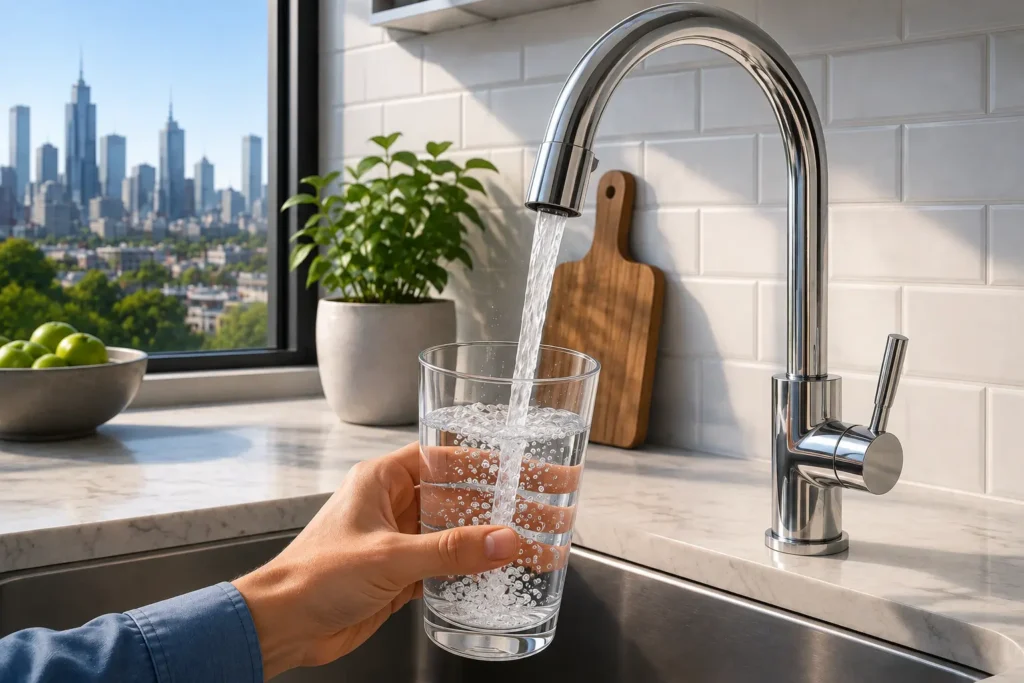
If you’ve ever filled a glass from the kitchen tap and caught a faint whiff of chlorine, or wondered why your kettle keeps building up a chalky residue, you’re not alone. It’s one of the most common questions Melbourne homeowners ask: is the water coming out of my tap actually safe?
The short answer is yes — Melbourne’s tap water meets Australian drinking water standards and is considered safe to drink straight from the tap. But “meets the standard” and “tastes great, feels great, and is exactly what you’d choose for your family” aren’t always the same thing. Here’s what’s actually in Melbourne’s water, why it sometimes smells or tastes off, and what it means for your household.
Where Melbourne’s Water Comes From
Melbourne is fortunate to draw most of its water from protected mountain catchments northeast of the city — places like the Yarra Ranges and Thomson catchment. Because these catchments are largely closed to public access and unaffected by agriculture or heavy development, Melbourne’s raw water starts out cleaner than water in many other Australian cities. Water suppliers like Yarra Valley Water publish annual water quality reports covering exactly what’s tested and found.
That said, “starts out clean” doesn’t mean it arrives at your tap untouched. Before it reaches your home, the water goes through treatment and travels through a network of pipes — some of which, particularly in older suburbs, can be decades old.
What’s Actually in Melbourne Tap Water
Chlorine and Chloramine
Water authorities add small amounts of chlorine (or chloramine) to disinfect the water and prevent bacterial growth as it travels through the pipe network. This is standard practice and essential for public health — but it’s also the reason some households notice a faint chemical smell or taste, especially in water that’s sat in pipes for a while (like first thing in the morning).
Sediment and Mineral Content
Even treated water can carry trace sediment, particularly after heavy rain events when catchment runoff increases, or in areas with ageing infrastructure. This won’t make the water unsafe, but it can affect clarity, taste, and — over time — contribute to buildup in kettles, hot water systems, and appliances.
Water Hardness
Melbourne’s water is generally considered “soft to moderate” compared to other Australian capitals, but hardness levels vary somewhat by suburb and source catchment. Harder water can leave spots on glassware, reduce lathering with soap, and gradually affect appliance efficiency.
Rust and Pipe-Related Particles
If your home has older galvanised steel plumbing, or if there’s been recent works on the street main, you might occasionally notice a slight discolouration or metallic taste. This is usually related to your property’s own plumbing rather than the treated water itself.
Why “Safe” Doesn’t Always Mean “Ideal”
Regulatory safety standards are designed around health risk thresholds — they tell you the water won’t make you sick. They don’t account for taste preferences, appliance longevity, skin sensitivity, or the cumulative effect of low-level exposure to chlorine and sediment over years of daily use.
This is why many Melbourne households — even though their water is technically safe — still notice things like:
- A faint chlorine smell, particularly in the shower where warm water releases more chlorine vapour
- Skin or scalp dryness after bathing
- A slightly “flat” or chemical taste compared to filtered or bottled water
- Spotting on dishes and glassware
- Appliances (kettles, coffee machines, hot water systems) needing more frequent descaling
None of these are signs of unsafe water. They’re simply the everyday, cumulative side effects of treated municipal water — and they’re the reason filtration has become such a common household upgrade rather than a niche one. (If the chlorine smell specifically is what bothers you most, we’ve broken down exactly why it happens and what you can do about it.)
Does Every Melbourne Home Need to Worry About This?
Not necessarily. Water quality can vary noticeably by suburb, depending on which catchment supplies your area, the age of local infrastructure, and whether your property uses tank or bore water for any part of its supply. Some households notice these issues daily; others barely notice them at all.
If you’re unsure whether your home falls into the “notice it every day” camp, a few practical signs to look out for include a persistent chlorine smell that doesn’t fade, visible sediment after periods of heavy rain, or appliances that seem to scale up faster than they should.
What You Can Do About It
For households that do notice these issues, options range from simple jug filters and under-sink units for drinking water, right through to whole house water filtration systems that treat water at every tap — kitchen, bathroom, laundry, and hot water system alike. Many Melbourne homeowners who use multiple outlets daily, have larger families, or are simply tired of the chlorine smell in the shower end up looking at whole house water filtration for their Melbourne home as a way to address the issue at the source, rather than filtering water one tap at a time.
It’s worth noting this isn’t unique to Melbourne. Households in other Australian capitals face similar treated-water trade-offs — for instance, Brisbane homeowners dealing with their own water quality quirks often reach for the same whole-home approach, tailored to their local supply.
The Bottom Line
Melbourne tap water is safe to drink by regulatory standards, thanks to well-protected catchments and reliable treatment processes. But “safe” is a baseline, not a ceiling — chlorine, sediment, and hardness can still affect taste, smell, and the long-term wellbeing of your plumbing and appliances. Understanding what’s actually in your water is the first step to deciding whether it’s simply fine as-is, or worth improving.
This article touches on health and water safety — treat it as general information, not a substitute for checking your local water authority’s current reporting for your specific suburb.