
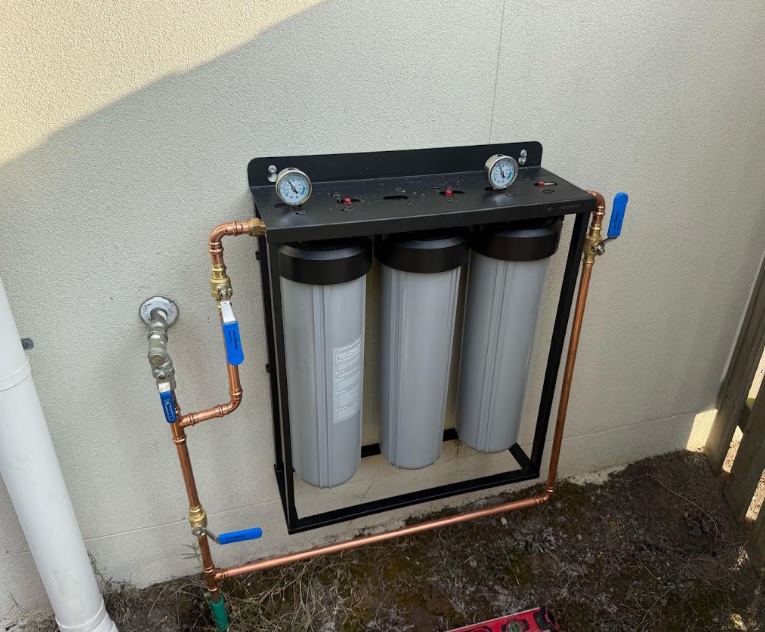
If you’ve started researching how to fix your home’s water quality, you’ve probably run into two very different sounding solutions: an under-sink filter and a whole house water filtration system. They solve overlapping problems, but they’re not interchangeable, and picking the wrong one for your situation means either overspending or still being stuck with the exact issue you were trying to fix. Here’s a clear breakdown of how they differ, what each actually covers, and how to figure out which one fits your household.
What Is an Under-Sink Water Filter?
An under-sink filter is installed directly beneath your kitchen sink, connected to the cold water line that feeds your kitchen tap (and sometimes a dedicated drinking-water tap). It filters water at that single point of use, typically for drinking and cooking water only.
Under-sink units are relatively inexpensive, simple to install, and effective at improving the taste and smell of the water you drink and cook with. However, they only treat water at that one tap. Everything else in your home, your shower, laundry, other bathroom taps, and your hot water system, still receives unfiltered water.
What Is a Whole House Water Filtration System?
A whole house water filter, sometimes called a point-of-entry filtration system, is installed at the point where the main water line enters your property, before it branches off to any individual tap or appliance. Because of where it sits, every single tap in the home, kitchen, bathrooms, laundry, and the hot water system, receives filtered water.
This is the key structural difference: an under-sink filter treats water for one use case, while a whole house water filtration system treats water for the entire property at once.
Whole House Filter vs Under-Sink Filter: The Core Differences
Coverage
Under-sink: one tap, usually kitchen drinking/cooking water only.
Whole house: every tap and appliance connected to the property’s water supply.
What It Addresses
Under-sink filters are generally focused on taste, odour, and drinking water quality. A full whole home filtration system can address broader issues too, chlorine smell in the shower, sediment affecting appliances, and water hardness across the entire property, depending on the system’s configuration.
Appliance and Plumbing Protection
Because it treats water before it reaches your hot water system, washing machine, dishwasher, and taps, a whole house system can help reduce sediment and scale buildup across all of these over time. An under-sink unit has no impact on anything outside the kitchen tap it’s connected to.
Installation
Under-sink filters are a simple DIY-friendly or quick trade job under the kitchen cabinet. Whole house systems are installed at the property’s main water line, which is a more involved job typically requiring a licensed plumber, but it’s a one-time install that then covers the entire home.
Cost Consideration
Under-sink units are cheaper upfront and cheaper to maintain, since there’s only one filter cartridge to replace. Whole house systems cost more initially, given the scope of what they cover, but eliminate the need for separate filters at every point of use.
Which One Actually Makes Sense for Your Home?
This comes down to what problem you’re actually trying to solve.
An under-sink filter is a reasonable fit if your only concern is the taste or smell of your drinking water, and you’re not bothered by anything happening at other taps in the house.
A whole house water filtration system tends to make more sense if:
- You notice chlorine smell in the shower, not just from the tap
- You’re dealing with limescale or hardness affecting multiple appliances
- You want to protect your hot water system and washing machine long-term, not just improve drinking water
- You have a larger household using multiple bathrooms and taps daily
- You’d rather solve the issue once at the source than manage filters at several points of use
Can You Use Both?
Yes, and in some cases this is actually the ideal setup. A whole house filtration system handles broad treatment (sediment, chlorine, sometimes hardness) across the entire property, while an additional under-sink or reverse osmosis unit can be added at the kitchen tap for an extra layer of drinking water refinement. They’re not mutually exclusive, they solve different layers of the same overall problem.
Bottom Line
An under-sink filter is a low-cost, narrow fix for drinking water at one tap. A whole house water filtration system is a broader, point-of-entry solution that treats water for your entire property, protecting appliances, plumbing, and every tap in the home, not just the kitchen. If you’re only troubleshooting drinking water taste, under-sink may be enough. But if chlorine smell, hardness, or appliance wear are showing up across multiple parts of your home, a whole house water filtration system for your Melbourne property is generally the more complete fix, since it treats the water once, at the source, rather than patching individual taps one at a time.
If you’re still weighing up your options, it’s worth having your specific water and household setup assessed before deciding, since the right system often depends on what’s actually in your water to begin with, not just a generic recommendation. You can see how a whole house water filtration setup is typically approached before making that call. If you’re specifically after drinking-water-only filtration, our Under Sink 6 Stage System covers that, and for a combined approach, our Whole House + Under Sink 3 Stage setup treats both.